

by Nancy Stratman, NDA Archivist
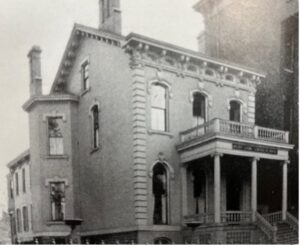
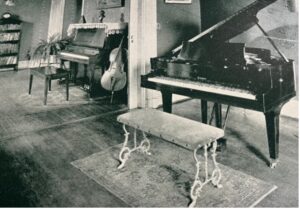
For 120 years, Notre Dame Academy has prided itself on providing each student with a well-rounded education including a strong and diverse academic program, a multi-sport athletic program and opportunities to explore and develop their artistic talents. The sounds of music have been reverberating throughout the halls of NDA for over 100 years. Because of the steady growth in both its grade school and high school programs by 1918, NDA leadership decided to expand the fledgling music and art classes into a full curriculum and subsequently purchased the Crawford Mansion, a two-story residence immediately east of the main building. In the fall of 1921, it became home to the Notre Dame School of Music. Initially, the first floor was dedicated to music classes and within a couple of years, the second floor became home to the academy’s fine arts program.
 .
. 
Laying the groundwork by offering several years of individual instrument and voice lessons, Notre Dame School of Music opened in September of 1926 “with a fine enrollment, the pupils as well as the faculty entering upon their work with new zeal and enthusiasm”. (The Gavel, 10/1926)
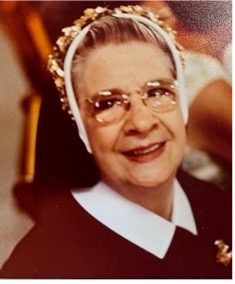
Led by Sr. Mary Irene and Sr. Mary Erma, the school of music operated from its own building (the old Crawford Mansion). Students were enrolled in six different departments: Piano, Voice, Violin, Harmony, History of Music and Form and Analysis. Students were offered opportunities to join the Notre Dame Choral Club and the Notre Dame Orchestra. “The 1st orchestra was formed under the direction of Sr. Mary Erma. We played on several different occasions and soon great interest was taken in our club. We also took part in the recitals given in our auditorium.” (Irene Cahill, class of 1928) “Under the direction of Sr. Marie Irene, voices have been tested for the Glee Club and soon the tuneful cadences will resound through the academic corridors. And the Junior B Sharp Club, primarily organized to give budding musicians a solid foundation in the rudiments of music and to increase the number of instruments available for student use. Clara Bramlage had been elected president of this student group.” (The Gavel, 10/1926)
Part 1: Orchestra and Concert Band (1926-1960)
At the start of the 1927-28 academic year, Mr. Garner Rowell of Cincinnati was introduced as the new director for the Notre Dame Orchestra. Consisting of 19 students, the new orchestra, assisted by the Notre Dame Glee Club, presented its first public performance in the school auditorium on January 20. Six different selections were performed by the orchestra, including “Surprise Symphony” (Haydn), “Indian Tale” (Wright) and “Opera Fantasia” (Maddy). These performances were interspersed with choral selections from the Glee Club, including “Shadows over the Sea” (West) and “Swing Low, Sweet Chariot” (Negro Spiritual). “Due to the professional efforts of the new teacher, the assembly achieved great success. The future musical prosperity of this group is practically guaranteed.” (The Gavel, Jan. 1928) Each year, the orchestra (eventually expanding into a concert band) would perform at the annual Christmas and Spring concerts, as well as year-end recitals.
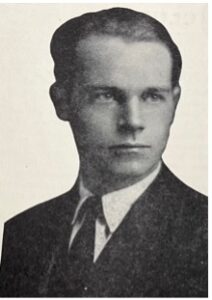
Seeing a potential lack of participation, the following year music teacher Garner Rowell wrote an editorial explaining his case for more students to become involved with the music department at Notre Dame. In the October 1930 issue of The Gavel, he wrote “The graduate, especially the girl graduate, is likely to be judged by her practical attainments, her accomplishments that can be readily displayed. In pursuit of these, no subject is more effective than music. No study, theoretical or practical, offers more definite and tangible results for the time, money and energy expended than music. Pianists we have in numbers and a fair representation of singers, but there is a long and interesting variety of other instruments that are entirely overlooked. First of all, the violin, of which we never have enough; the viola, a favorite of the masters; the cello, chosen by the greatest of modern instrumentalists, Pablo Casals; and, the double bass, on which I have heard entrancing solos. The wind instruments too offer an attractive selection of instruments for the young land to play. There is a very different situation in Europe; almost everyone plays an instrument and, apparently, very well. Very likely that is responsible for their artistic atmosphere and for our mechanical one. Let’s do something about this!” Evidently, the students came to understand the importance of music. For the next decade, the NDA orchestra would flourish under the direction of 3 male conductors: Garner Rowell, Frank Dowd and Dean Bloss as seen from the following excerpts from The Gavel.
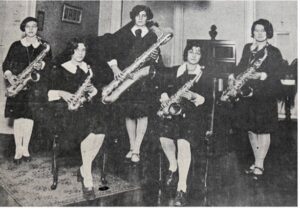
“The Glee Club and the Orchestra are going to take part in the Christmas performance this year. The orchestra will accompany the chorus in several selections. A unique feature of the program will be a rendition of “Silent Night” arranged by Mr. Rowell for our saxophone quintet, led by B-flat soprano Billie Wulfeck.” (The Gavel, 12/1928)
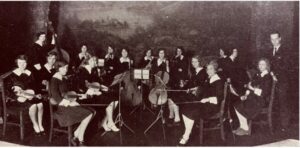
(NDA orchestra, June 1930 directed by Mr. Garner Rowell)
“The Notre Dame orchestra has been re-organized during the past week under the direction of Mr. Garner Rowell. With the opening on this school year, twelve students have registered for the orchestra: 5 students for violin, 1 student for viola, 1 student for drums, 2 students for saxophone, 2 students for cello and 1 student for piano.” (The Gavel, 10/1929)
“Blasts and thumps from the sewing room indicate that Notre Dame band members, both old and new, are rehearsing for coming events. The band now includes 5 members on trumpet, 2 on trombones, 5 on saxophone, 6 on clarinet and 2 on drums under the direction of Mr. Frank Dowd.” (The Gavel, 10/1936)
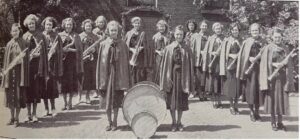
(1936/37 NDA Concert Band)
“The Notre Dame Band has been re-organized under the capable direction of Mr. Dean Bloss. The new director intends to have a demonstration in January with all members and a Spring Concert with the band and the choral club combined. The band now consists of 7 students on trumpets, 10 on clarinets, 5 on saxophones, 2 on trombones, 1 on bells and 3 on drums and cymbals.” (The Gavel, 12/1938)
During the 1940s, while there were always a few students who were interested in providing instrumental accompaniment during school concerts and musical plays, formal lessons and participation in an orchestra/band began to lessen.
And then, during the 1959-60 academic year, the NDA band seems to have had a resurgence under the direction of Sr. Mary Judithe. There were 17 musicians and the Gavel article seems to suggest that this was a newly formed group who were still mastering their instruments. “The Wednesday sessions find the students in varying degrees of mastering their instruments seeking precision of tone and exactness of rhythm. Often, however, a jovial note is experienced when an unwarranted saxophone groan or a misfit piano chord leaks into the peaceful corridors. Despite these disappointing factors, the optimistic music makers agree that the band has a potential which will blossom forth at the spring concert. True mastery in the field of musical composition and presentation, however, is not the only positive outcome of their time. Ask any of the girls and she will say “The band’s greatest asset is the fun we’ve had in working with others and to hear music of our very own.” (The Gavel, 10/1959)
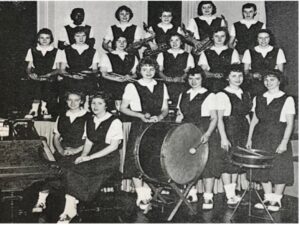
Unfortunately, by the time the Academy moved to their new Hilton Dr. campus in the fall of 1964, it seems that the interest in an organized orchestra or band activity had died out, unlike the interest in singing. The desire for vocal lessons and participation in the Choral Club had been a strong presence at Notre Dame since its inception in the 1920s and continued to grow immensely during the next several decades.
Part 2: Vocal Lessons and Choral Clubs (1925-1990)
For many years, groups of students from each grade level would join together throughout the school year to perform during the annual Christmas and end of the year assemblies. During the early 1920s great interest was shown in forming a club specifically directed towards promoting the advancement of choral singing. Thus, the Notre Dame Choral Club was established at the beginning of the 1925-26 academic year, a year before the School of Music officially opened.
Under the direction of Sr. Marie Irene, interested juniors and seniors would have their voices tested for range and depth at the beginning of the academic year and were then invited to join the glee club. To supplement the efforts of the glee club, a new course in the study of music was inaugurated in 1928 motivated by a desire on the part of the faculty to acquaint the students with the cultural side of music education. Theory, chorus work, appreciation and history of music were subjects contained in this course.
By the following year enrollment in the music classes had seen such an increase, the former Glee Club had grown into three offshoots. “Selected students from the first-year high form the Junior Choral Club, while upper class women compose the Senior Choral division. Six students were selected to form The Songstars and will be trained for exceptional programs.” (The Gavel, 11/29)
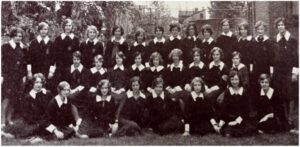
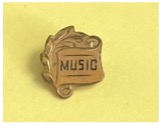
For the first time during the fall honor convocation in 1931, students who were members of the School of Music, were awarded Honor Ribbons. The ribbons were conferred for “regularity in lessons, assiduous practice, and the mastery of given assignments during the first quarter”. When introducing this new honor ribbon, faculty members stated that “in music, as in no other art, constant application is the keynote of success. Therefore, pubic recognition to the work accomplished should be given to those students.” (The Gavel, January 1932) At the end of the year, students holding 2 honor ribbons for the year received a silver pin; those who held 4 ribbons received a gold pin.
By the start of the 1936 school year, the Choral Club had increased its enrollment to 60 members: 14 freshmen, 17 sophomores, 17 juniors, and 12 seniors. They performed a variety of choral selections for the Christmas and Spring Concerts under the direction of Mr. Leo Grote.
Fifty members of the Choral Club decided to use their wealth of Christmas carols to cheer their shut-in neighbors during the holiday season that year. “Donning gay red hats and long flowing red ties, they traveled to the St. Elizabeth Hospital in Covington and then to the St Joseph Orphanage in Cold Spring using their fresh young voices to bring the Christmas message and old and young alike. Afterwards, they crossed the Ohio River and visited the St. Mary Hospital and then the Florence Avenue Home for the Aged”. (The Gavel, January 1937)
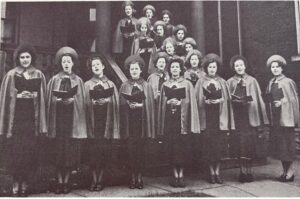
In late April of 1939, under the direction of Mr. Richard Fluke, the new Director of Music, the 27 senior and junior members of the Choral Club traveled to Lexington to compete in the annual Kentucky High School Music Festival, Division A. “Valse Triste”, by Sibelius was chosen as the choral club selection. The Choral Club received a rating of SUPERIOR in the Girls Glee Club competition.
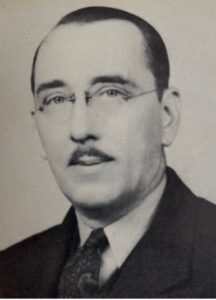
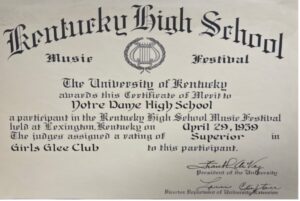
Choral Club continued to grow under the direction of Mr. Richard Fluke presenting concerts at Christmas and in the spring. For several of the concerts, Mr. Fluke invited talented local musicians as guest accompanists. These included the well-known pianist Mrs. Albion Ritte and servicemen Private Paul Jones and Corporal Gene Addams who were home on leave.
In September of 1958, Choral Club was under the direction of Mr. David Ahlstrom, with Sr. Mary St. Clare as the primary accompanist. He left in December of 1959 to pursue his first love of composing. As a tribute to Mr. Ahlstrom, two of his original compositions were included in the spring concert, under the direction of Mr. Herbert Louis, who finished the academic year as chorus director.
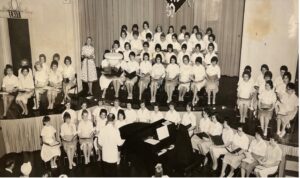
(Spring, 1960 concert under the direction of Mr. Herbert Louis, featuring his wife, Mrs. Dorothy Louis as soloist.)
During the 1960s, Sr. Mary Judithe took over the reins of the music departments at NDA and laid the groundwork for the vibrant performance art that would last for years. During her tenure as the lead musical teacher, new opportunities for exploring the world of music for all NDA students grew, and participation in the choral clubs blossomed. Using her personal mantra, “without music we cannot be fully human”, Sr. Judithe introduced a class in Music Appreciation for all sophomores, giving the opportunity to learn about music. Students in all grade levels were invited to join the Choralettes or the Choral Club (depending upon grade level) and/or take private lessons, which were offered in piano, voice and guitar. Her goals for the music department were to enable the student to become culturally aware, to discover how music reflects the customs, feelings and artistic preferences of man, and to learn to listen to music actively and perceptively, not just passively. (The Gavel, April 1967)
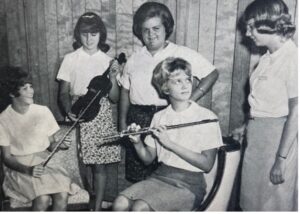
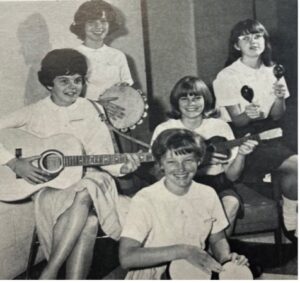
(April, 1967. Sophomore students try out various instruments during Music Appreciation classes.)
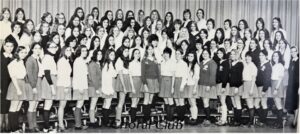
In hopes of developing the department of music even more, Sr. Mary Judithe hired Mr. Clyde Herndon to be the new choral director at NDA. During these years, the Choral Club grew in numbers and divided into two performance groups- the Choralettes for the underclasswomen and the Choral Club for the upperclasswomen. During the 1960-61 academic year there were 70 members of the Choral club; by 1967 there were 185 members. Senior members of the Choral Club received gold pins to mark the number of years they had been members of the choral ensembles.
During his tenure as Chorus Director at Notre Dame, Mr. Herndon established several new practices which helped to grow and unify the choral club. In coordination with Sr. Judithe, Mr. Herndon would enhance the choral concerts with the addition of musical artists from the community playing as a string quartet or featured conductor. The choral club adopted a uniform look for all performances that included a white skirt and blouse, accented by red vests trimmed in gold. These “choral uniforms” would even be worn when the chorus members visited community establishments, such as St. Charles Nursing Home or performing with the Civic Symphony of Cincinnati and the Kentucky Music Festival. For the 1962 Christmas concert, Mr. Herndon invited NDA alumnae and their children to join the NDA chorus as they presented a “Past, Present and Future” concert. Approximately 50 alumnae members comprised the “past”. The choral club was the “present” and children of the alumnae represented the “future”. Also, throughout this decade, Sr. Judithe was assisted by Sr. Mary Caroline, Sr. Mary Janeen, Sr. Mary Cecil, Sr. Mary Annett, Sr. Mary Carleta, Sr. Mary Marlene, Sr. Mary Clare Ann and Sr. Mary Damien.
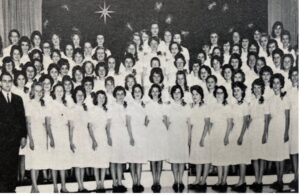
(1964, Mr. Clyde Herndon and the NDA Glee Club)
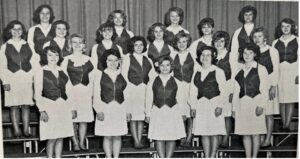
(Senior chorus members, Christmas Concert)
In 1969, Sr. Mary Barbara Rose joined the NDA faculty replacing Sr. Mary Judithe who was transferred to Carroll High School in Dayton, Ohio. Under the direction of Sr. Mary Barbara Rose, the music department at NDA continued to thrive and grow, while adding her own special touches to make the department a little more unique and fun for all participants. In preparation for upcoming concerts, Sr. Mary Barbara Rose would hold “marathon” rehearsal sessions on Thursday evenings from 2:30-8:00pm. And, even though the majority of the time was spent rehearsing upcoming musical pieces, there was time taken out for small activities, games and dinner fostering a true family atmosphere for all participants. Concerts became multi-faceted, including choral selections combined with solo performances, songs accompanied by student musicians, and visual accents and original set backgrounds provided by student artists. The choral club also promoted additional school activities, such as a spring variety show, open to all students. Sr. Mary Barbara Rose also promoted the choral clubs through outside venues, presenting concerts at local high schools and the University Club of Cincinnati, as well as retirement homes and civic club meetings.
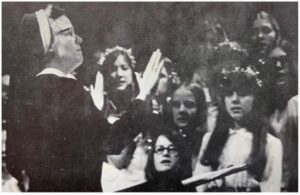 (1972 Sr. Barbara Rose conducts the Choralettes)
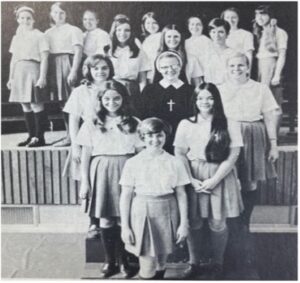
(1970 Junior Chorus and Sr. Barbara Rose)
At the beginning of the 1977-78 academic year, the 52-year tradition of having a Sister of Notre Dame oversee and/or coordinate the music programs at Notre Dame came to an end.
In September of 1977, Sr, Mary Barbara Rose was transferred to St. Monica Parish in Bardstown, Ky and she was replaced by Mrs. Elizabeth Pavone as Music department Chair. During the next 15 years, the Choral Club continued under the leadership of several directors, including Mrs. Elizbeth Pavone, Mrs. Pam Runyan, Mrs. Marlene Bosch, Mr. Randall Lawrence, Mrs. Therese Blanc, and Mrs. Nancy Schlothauer with Mrs. Donna Guillaume providing a continuing thread of stability as the Music Appreciation teacher and chorus accompanist for many years.

(from left to right: Elizabeth Pavone, Pam Runyan, Marlene Bosch, Randall Lawrence, Theresa Blank, Nancy Schlothauer, Donna Guillaume)
PART 3: STABILITY AND GROWTH OF VOICE AND INSTRUMENT (1992-2017)
In the fall of 1992, Ms. Renee Harris joined the faculty splitting her teaching duties between accounting and music. In the area of vocal music, she revived a flagging choral club and sought to revitalize an interest in the orchestra. During her first year on staff, Ms. Harris invited interested musicians from surrounding diocesan high schools and formed the Diocesan High School Band. In 1994, she became chair of the music departmentand under her leadership, interest and participation in both the choral club and the orchestra grew once again. She established a piano lab located next to the choral room, where she would teach piano lessons and in 1998 was awarded the Margaret Hall Foundation for Music Grant of $10,000 to expand the piano lab. Under the direction of Ms. Harris, the music curriculum was restored and expanded to include classes in music appreciation, chorus, voice and piano. The annual vocal and band concerts were now supplemented by musical theatre productions with full chorus and band accompaniment and student participation in the performing arts increased to include over 50% of the student body.
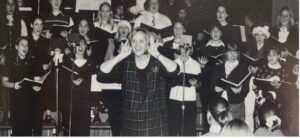
(Ms. Renee Harris and the choral club perform at the annual Christmas Concert.)
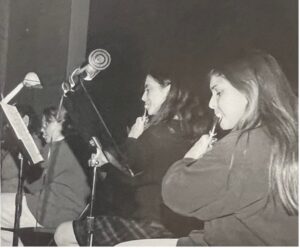
As student interest in the musical and performing arts grew from both NDA and CCH students, Sr. Rita Geoppinger (NDA principal) saw the need for a dedicated orchestra leader to direct the pit orchestra during musical theatre productions. In September of 1997, Mr. Greg Cerimele joined the NDA faculty. Lured from his job as music teacher from St. Agnes grade school, Mr. Cerimele (affectionately known as “Sir” by his students) brought to NDA a wealth of musical experience on a variety of instruments, but also with degrees in mathematical education and an interest in information technology.
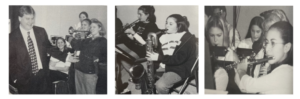
Under the leadership of Ms. Harris and Mr. Cerimele, the vocal and instrumental performing arts at NDA solidified, offering strong and diverse opportunities for those students seeking participation. The choral club and the orchestra were showcased at the Christmas and Spring concerts, providing accompaniment for theatrical productions and graduations, while also participating in Diocesan competitions.
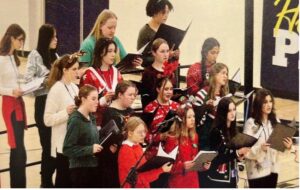
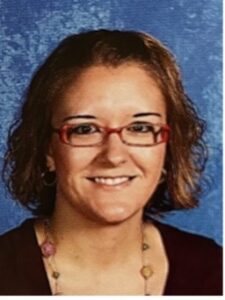
In 2003, Ms. Lori Wainscott joined the NDA faculty as the speech and theatre teacher, and then took over the role of chorus director when Ms. Harris stepped down to pursue other professional opportunities. Though still considered an extracurricular activity, the number of students joining the chorus club continued to grow and eventually divided into a general chorus and a select chorus named The Singing Dames. This stability continued under the successive leadership of Mrs. Nell Schaffer Bosse (2012-2016) and Ms. Erin McCamley (2016-2017).
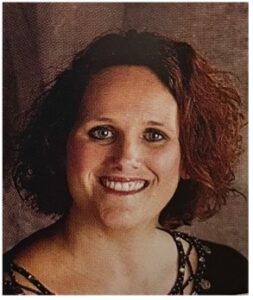
Mrs. Nell Schaffer Bosse
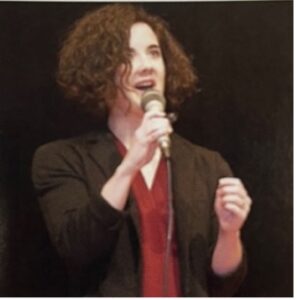
Ms. Erin McCamley
PART IV: THE LEGACY OF MUSIC CONTINUES TO ECHO (2017-present)
Knowing that there would be an opening for choral director in the fall of 2017, Mr. Cerimele put out a call to former NDA student Kelsey Cummings and offered her the position. “When Mr. Cerimele reached out to me, I felt it was a full circle moment – a faith filled sign to return to NDA. As a student, I loved being involved in chorus and performing in the theatrical shows, as well as singing at Mass. I thought to bring together what I learned at NKU’s SOTA program with the experiences I cherished as a student and therefore, continue the rich traditions of the vocal arts at Notre Dame.” (personal reflection, Kelsey Cummings Chandler) During the past nine years, Mrs. Chandler has seen the number of regular and select chorus members fluctuate (especially after Covid) but continues to lead a solid group of interested and talented students who love to share the musical gifts that God has given them. She says that she feels “an incredible sense of fulfillment every time I stand in front of the chorus and see their faces as they perform for their families and friends. It is truly rewarding to watch them light up on stage and feel proud of the hard work they have put into their performance.” (personal reflection, Kelsey Cummings Chandler)
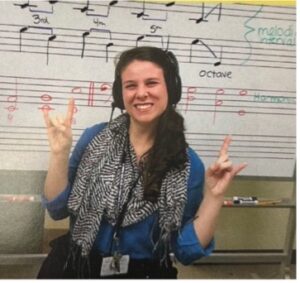
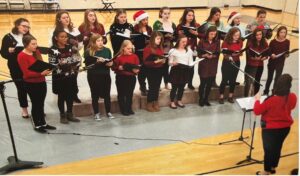
(Mrs. Kelsey Cummings Chandler conducts The Panda Tones (select choir) during the 2017 Christmas Concert)
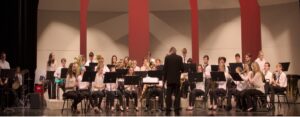
Since his arrival at NDA in 1997, Greg Cerimele has been the pillar of strength and stability within the musical arts department. Never in the history of NDA has there been a vocal or instrumental teacher whose tenure has created such constancy and also variety for the musical arts. At his initial interview, Sr. Rita Geoppinger (NDA principal) told him that she didn’t need a math teacher, although that was a good selling point, what she really needed was someone to conduct the pit orchestra for the yearly musicals. The rest is history. Starting with the “Sound of Music” in 1998, Greg developed and directed the pit orchestra for the annual musicals until the production of “Anything Goes (2017) by which time, the orchestra had grown so large that the audience couldn’t hear the vocalist over the music. Combining NDA students with interested students from CCH, Mr. Cerimele adopted the motto of “Our Spirit Makes a Difference” and turned the pit orchestra into a concert band followed quickly by the creation of a jazz band and a pep band which performs during halftime at various NDA/CCH sports events, even traveling to Rupp arena last year for district and state competitions. He has formed an Honors Band comprised of his more advanced students who have taken part in the yearly NKU Instrumental Symposium. One of his biggest projects was the formation of a marching band, providing half-time entertainment at CCH football games and participating in local parades. Prior to Covid, membership in the marching band hovered around 40 high school members for many years, with all band members in uniform and often allowing for student conductors to showcase their talents.
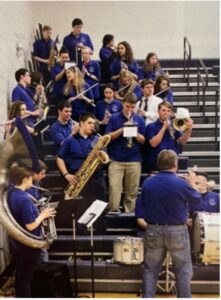
Always looking to provide avenues for potential growth, Mr. Cerimele and his mother Mrs. Rita Cerimele (an accomplished musician and junior band teacher in Cincinnati) started a free summer learning band called “Hot Cross Buns” for beginning students where everyone started from scratch. They also established a junior high band for grades 5-8, which would play with the high school band on several occasions. Their biggest concert was performed at the Devou Park band shell, where over 75 students performed.
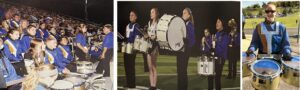
After 29 years, Mr. Cerimele is often referred to NDA’s “Music Man” and has no plans to retire any time soon. He has grown band from an after-school club to a 1/2-credit Fine Arts class. He also continues to hold free band instruction and practice every Monday after school (“If it’s Monday, It’s Band!) and throughout the summer for all interested students. Even while teaching a full schedule of Math classes during the academic year, Mr. Cerimele (now assisted by his son Joel) offers interested students a full slate of band activities throughout the year: half-time marching band performances at CCH football games, open house jazz band, Christmas concert band, pep band during NDA basketball games, Spring concert band, Fine Arts jazz band and concert band for both NDA and CCH graduations.
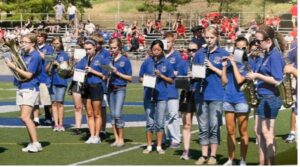
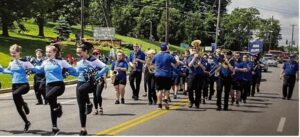
From the humble beginnings of a saxophone quartet and 15-member glee club, the dream of Sr. Mary Irene and Sr. Mary Erma for a viable instrumental and vocal program at Notre Dame Academy has flourished and grown over the years and will now celebrate 100 years of performance in September of 2026. Come celebrate with us as Mrs. Kelsey Chandler and Mr. Greg Cerimele wave their conductor batons into the future!